Does the Religious Freedom Movement Measure India Fairly?
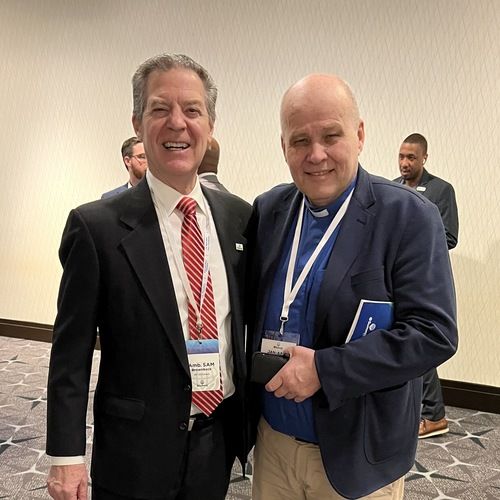 Jan-Aage Torp with Ambassador Sam Brownback, 2023.
Every year, a handful of reports and rankings decide how the world talks about religious freedom. A U.S. commission issues its recommendations, the State Department publishes its annual report, research institutes produce their indices, and Christian watchdogs publish their lists of the countries where believers suffer most. Churches, journalists, investors and governments quote the results, often as if they were settled fact.
India, the world's most populous nation, sits near the top of several of these lists. I want to ask whether the way the international religious freedom community measures India is fair and proportionate. I do not ask to score points. I ask because I believe the system is strong enough to look honestly at itself, and because the people who built it are the best placed to do so. One of them stands out: Sam Brownback.
What Sam Brownback built
Few people have done more for religious freedom in our generation than Sam Brownback. I have had a few friendly conversations with him over the last four years, and each time I have been struck by the same thing: he means it. For him, the freedom to believe, to worship, to change one's faith and to share it is not a slogan. It is the first freedom, and he has spent a lifetime defending it.
As a United States Senator from Kansas, Brownback was, in the words of the State Department, "a key sponsor of the International Religious Freedom Act of 1998." That Act established the independent U.S. Commission on International Religious Freedom (USCIRF) and the State Department's Office of International Religious Freedom. It requires the annual State Department Report on International Religious Freedom, and it is the law under which the Secretary of State designates "Countries of Particular Concern" for "systematic, ongoing, egregious violations of religious freedom."
Later, from 1 February 2018 to 20 January 2021, Brownback served as the U.S. Ambassador-at-Large for International Religious Freedom. In other words, he did not only help write the architecture. He ran it. Today he co-chairs the annual International Religious Freedom (IRF) Summit in Washington, D.C.
Millions of persecuted believers around the world, Christians, Muslims, Baha'is and others, have had a voice in Washington because of that work. I want to say that clearly before I say anything else.
No denial
Let me also say clearly what I am not saying. India, which in April 2023 passed China as the world's most populous nation according to the United Nations, has well over 1.4 billion people. In a nation of that size there will be religious extremists who attack other faiths. Pastors are harassed, prayer meetings are reported to the police, and Muslims and Christians have suffered violence. That is beyond a shadow of a doubt. Every victim matters.
My question is not whether these things happen. It is whether the way we measure them, and the language we use about a whole nation, is fair and proportionate.
Question one: Why the gap between USCIRF and the State Department?
In April 2020, USCIRF for the first time recommended that India be designated a Country of Particular Concern, the category shared by countries like China, Iran and North Korea. USCIRF has repeated that recommendation every year since, including in its 2026 report.
Yet the State Department, which alone has the authority to designate, has never done so. Not under President Trump, not under President Biden. USCIRF itself has publicly protested that State "yet again failed to designate Nigeria and India."
Ambassador Brownback will remember this well, because the first decision fell on his watch. In December 2020, when a journalist asked him why India was not designated, he answered honestly: "There were several recommendations made by the commission that the Secretary did not follow, and this was one of them." He added that the U.S. watched India "very closely" and that the Secretary had raised these issues "at the highest levels."
I respect that answer. But it leaves the public with a puzzle. In European church circles and media, the USCIRF recommendation is routinely quoted as if it were the verdict of the U.S. government. It is not. Two parts of the same system have looked at the same country and reached different conclusions year after year since 2020. Few people could explain why better than Brownback, and how that difference should be communicated to the rest of us.
Question two: Whose data is it, really?
The figure most often quoted against India is Pew Research Center's Social Hostilities Index. For 2023, Pew gave India 8.8 out of 10, "very high", higher than Pakistan at 7.5 and just below Nigeria at 9.0. Pakistan, it should be remembered, is one of the countries the State Department has actually designated a Country of Particular Concern.
Pew is a respected institution, and its index is often presented as independent science. But Pew's own methodology explains that for a large block of the social hostilities questions, its coders look at incidents in the State Department's International Religious Freedom reports from the previous two years. Pew also states plainly that it does not attempt to adjust for differences in size and population between countries.
Those individual country reports have not been published since 2024; the last edition, released in June 2024, covers the year 2023.
Now put that next to Pew's own field research. In a landmark survey of 29,999 face-to-face interviews across India, conducted between November 2019 and March 2020, Pew found that 89 percent of Indian Christians, and 89 percent of Indian Muslims, said they were "very free" to practise their faith.
Professor Salvatore Babones of the University of Sydney has made this point in print. Writing in Firstpost in February 2023, he pointed out that Pew did not revise its index in the light of its own survey, and that the index rests mainly on complaints summarised in the State Department reports. In Quadrant the same day he put the size problem in one sentence: "everything that can happen is likely to happen somewhere in a country of 1.4 billion people."
So the question is a simple one. An index that counts whether certain kinds of incidents occurred at all, drawn largely from reports created by the 1998 Act, and not adjusted for population, will almost inevitably place a vast, open and noisy democracy near the top. Is that what the authors of the Act intended? Brownback, as one of them, is the obvious person to answer.
Question three: Can complaint-driven reporting be gamed?
The State Department reports are built in part on what governments, journalists and advocacy organisations submit. That openness is a strength. It is also a vulnerability.
Babones gave an example in his Firstpost article. In the State Department report he examined, the Department itself documented 20 attacks on Christians, seven on Muslims and five on Hindus across India. It then cited seven Christian advocacy organisations alleging hundreds of additional attacks, without establishing whether those claims overlapped.
I am a Pentecostal pastor. I am not saying that Christian advocates invent their cases. Many of them do brave work. But any well-organised network, Christian or otherwise, can flood a complaint-driven system with reports. When national scores and the language of "systematic, ongoing, egregious" violations are then applied to a federal democracy of 28 states and 1.4 billion people, with vast regional differences, the result can be a picture that the people on the ground do not recognise.
This is not a small matter. Labels like these shape how churches, investors and governments treat India. And they shape how Indians, including Indian Christians, see the West's commitment to fairness.
A challenge and an invitation
These questions are addressed to the whole religious freedom community: the commissioners, the researchers, the advocacy networks and the churches that quote them. But one man is better placed than anyone to answer them. Sam Brownback has defended religious freedom with conviction all his life, and nobody can accuse him of being soft on persecution. That is exactly why I challenge him to take these questions seriously.
He does not need to answer every point now. These are questions for a serious, unhurried conversation, and there is a natural place for it. The next IRF Summit, which he co-chairs, takes place in Washington, D.C. on 1–3 February 2027. I would welcome it if he brought the question of how we measure India to that gathering. I have not been at the Summit for the last three years, but I will do my best to be there this time.
I would also like to invite him to a conversation on my programme Insight, to discuss how the international religious freedom system measures a country like India, what it gets right, and what could be done better. I have discussed India's democracy on the same programme with Professor Babones and with Erik Solheim, the former UN Under-Secretary-General and head of the UN Environment Programme. Brownback's voice would add something no one else can: the perspective of the man who helped build the system and then led it.
Defending persecuted believers and treating a great nation fairly are not opposites. They belong together. I hope the religious freedom movement can show that, and that Sam Brownback will help lead the way.
Sources
1. U.S. Department of State, Former Ambassadors, Office of International Religious Freedom (Brownback "a key sponsor of the International Religious Freedom Act of 1998"; served 1 Feb 2018 – 20 Jan 2021). https://www.state.gov/former-ambassadors-office-of-international-religious-freedom
2. USCIRF, 28 July 2017: USCIRF Praises Nomination of a New Ambassador-at-Large (IRFA "established USCIRF and the State Department's Office of International Religious Freedom"). https://www.uscirf.gov/news-room/releases-statements/uscirf-praises-nomination-new-ambassador-large-international
3. U.S. Department of State: International Religious Freedom Reports (annual report under section 102(b) of IRFA; last published edition is the 2023 report, released 26 June 2024). https://www.state.gov/international-religious-freedom-reports/
4. U.S. Department of State, 7 Dec 2020 (Secretary Pompeo): United States Takes Action Against Violators of Religious Freedom (CPC list under IRFA; India not included). https://2017-2021.state.gov/united-states-takes-action-against-violators-of-religious-freedom-2/
5. U.S. Department of State, 8 Dec 2020: Ambassador Brownback briefing ("There were several recommendations made by the commission that the Secretary did not follow, and this was one of them."). https://2017-2021.state.gov/ambassador-at-large-for-international-religious-freedom-samuel-d-brownback-briefing-on-rollout-of-u-s-actions-against-religious-freedom-violators/
6. UN DESA, 24 April 2023: India to overtake China as world's most populous country in April 2023. https://www.un.org/en/desa/india-overtake-china-world-most-populous-country-april-2023-united-nations-projects
7. USCIRF, 28 April 2020: USCIRF Releases 2020 Annual Report (first India CPC recommendation). https://www.uscirf.gov/news-room/releases-statements/uscirf-releases-2020-annual-report-recommendations-us-policy
8. USCIRF, 15 Dec 2023: "USCIRF has recommended each year since 2020 that the U.S. Department of State designate India as a CPC". https://www.uscirf.gov/news-room/releases-statements/uscirf-deeply-concerned-indias-transnational-repression-against
9. USCIRF, 4 Jan 2024: State "yet again failed to designate Nigeria and India". https://www.uscirf.gov/news-room/releases-statements/uscirf-calls-congressional-hearing-after-state-department-fails
10. The Wire, Nov 2025: USCIRF's 2025 report recommended India "for the sixth time"; State has not acted. https://thewire.in/communalism/uscirf-says-bjp-and-rss-ties-enable-discriminatory-laws-in-india
11. The Diplomat, 5 March 2026: USCIRF's March 2026 report again recommends India; the State Department has not released an IRF report since the June 2024 edition, covering 2023. https://thediplomat.com/2026/03/the-us-hasnt-designated-violators-of-international-religious-freedom-since-2023/
12. U.S. Department of State, 30 Nov 2022: 2022 Religious Freedom Designations (Pakistan a CPC; India on neither list). https://2021-2025.state.gov/2022-religious-freedom-designations/
13. Pew Research Center, 15 June 2026: Religious restrictions in the 25 most populous countries in 2023 (India SHI 8.8; Pakistan 7.5; Nigeria 9.0). https://www.pewresearch.org/religion/2026/06/15/religious-restrictions-in-the-25-most-populous-countries-in-2023/
14. Pew Research Center, 18 Dec 2024: Restrictions on religion 2022 – methodology (SHI coders use State IRF reports from the previous two years; no adjustment for size or population). https://www.pewresearch.org/religion/2024/12/18/restrictions-on-religion-2022-methodology/
15. Pew Research Center, 29 June 2021: Religious freedom, discrimination and communal relations (89% of Christians and Muslims "very free"). https://www.pewresearch.org/religion/2021/06/29/religious-freedom-discrimination-and-communal-relations/
16. Pew Research Center, 12 July 2021: 8 key findings about Christians in India (29,999 interviews, 17 Nov 2019 – 23 March 2020). https://www.pewresearch.org/short-reads/2021/07/12/8-key-findings-about-christians-in-india/
17. Salvatore Babones, "Another index gone wrong: How Pew's Religious Freedom Rankings misrepresent India", Firstpost, 20 Feb 2023. https://www.firstpost.com/opinion/view-from-abroad-another-index-gone-wrong-how-pews-religious-freedom-rankings-misrepresent-india-12179502.html
18. Salvatore Babones, "Unholy Alliance: Inside the Campaign to Pry India from the West", Quadrant, 20 Feb 2023. https://quadrant.org.au/opinion/qed/2023/02/unholy-alliance-inside-the-campaign-to-pry-india-from-the-west/
19. Insight: India's Democracy: A Different Story (with Salvatore Babones and Erik Solheim, 28 March 2026). https://e-a-l.eu/tv/read1/salvatorebabones-eriksolheim0
20. Wikipedia: Erik Solheim (UN Under-Secretary-General and Executive Director of UNEP, 2016–2018). https://en.wikipedia.org/wiki/Erik_Solheim
21. IRF Summit: Registration (IRF Summit 2027, 1–3 February 2027, Washington Hilton, Washington, D.C.; co-chaired by Ambassador Sam Brownback and Dr. Katrina Lantos Swett). https://irfsummit.org/register/
